A LEGACY OF SERVICE: COMMEMORATING THE 50TH ANNIVERSARY OF DR. DAVID MATHEWS’ LEADERSHIP AT HEW
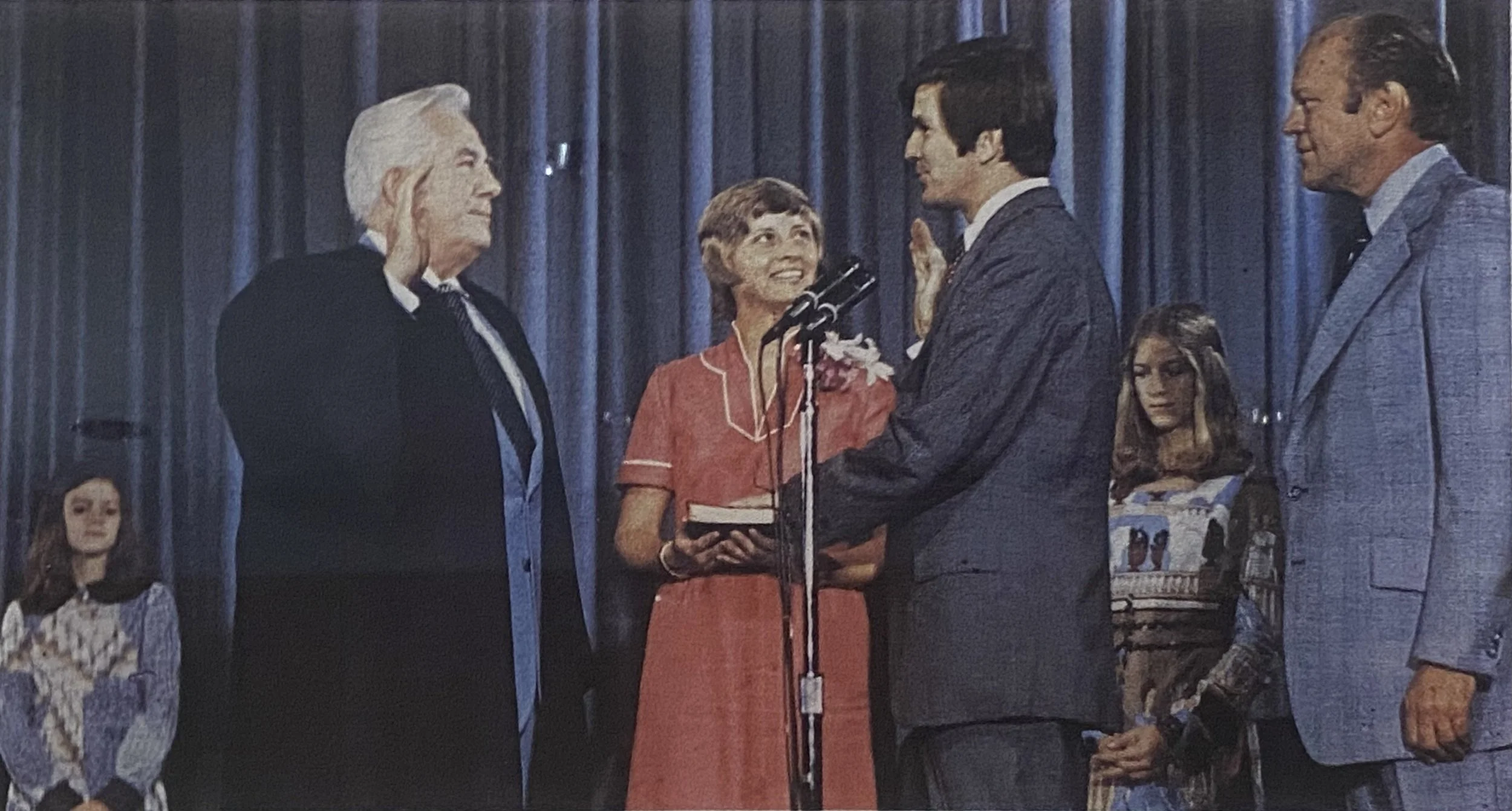
Chief Justice Warren Burger administers the oath of office to Dr. David Mathews, August 8, 1975. He was joined by his wife Mary, their two children Lucy and Lee Ann, and President Gerald R. Ford.
On August 8, 1975—fifty years ago today—Dr. David Mathews became the eleventh person to serve as Secretary of the U.S. Department of Health, Education & Welfare (HEW). Today, the David Mathews Center for Civic Life invites you to reflect with us on the anniversary of his swearing-in ceremony in Washington, DC.
When he was nominated by Pres. Gerald R. Ford in June 1975 to replace outgoing HEW Secretary Caspar Weinberger, Mathews was the quintessential Washington outsider. President of the University of Alabama since 1969, Mathews was a young and able administrator. President Ford had first become acquainted with Mathews during his service on an advisory council for the American Bicentennial. “I never thought that I was sent to save Washington,” Mathews wrote in his 2022 book With: A Strategy for Renewing Our Democracy. “I was an outsider and I was happy to be seen as from ‘the provinces.’ I thought that perspective could be put to good use. I wanted to share what I had seen... I also wanted to understand Washington’s way of seeing the country.”
The task Ford chose for Mathews was not an easy one. With thousands of employees and a budget greater than $100 billion, HEW’s scope and size dwarfed most other federal agencies. “We were at the center of the regulatory universe on the most sensitive subjects,” Mathews later recalled. Coming a year after the resignation of President Nixon, public trust in government remained low.
Although some Inside-the-Beltway observers questioned Ford’s choice, few people who knew Mathews well doubted his ability to succeed. “As Alabamians we have reason to be proud of the job David Mathews has done at the University of Alabama,” wrote Donald Comer Jr., president of Sylacauga’s Avondale Mills. “As Americans many more of us will have reason to be proud of the job he will do in the President’s cabinet.”
Some political observers regarded HEW as an ungovernable agency choked by overlapping, complex mandates. But as he reflected on his time at HEW in a 2010 interview with presidential historian Richard Norton Smith, Mathews offered a different view. “What looked like a hodgepodge of programs was actually components of a fairly coherent vision for the department: compassion for those who needed help; protection for those who needed to be protected against dangerous foods and drugs; justice for those who were underserved.”
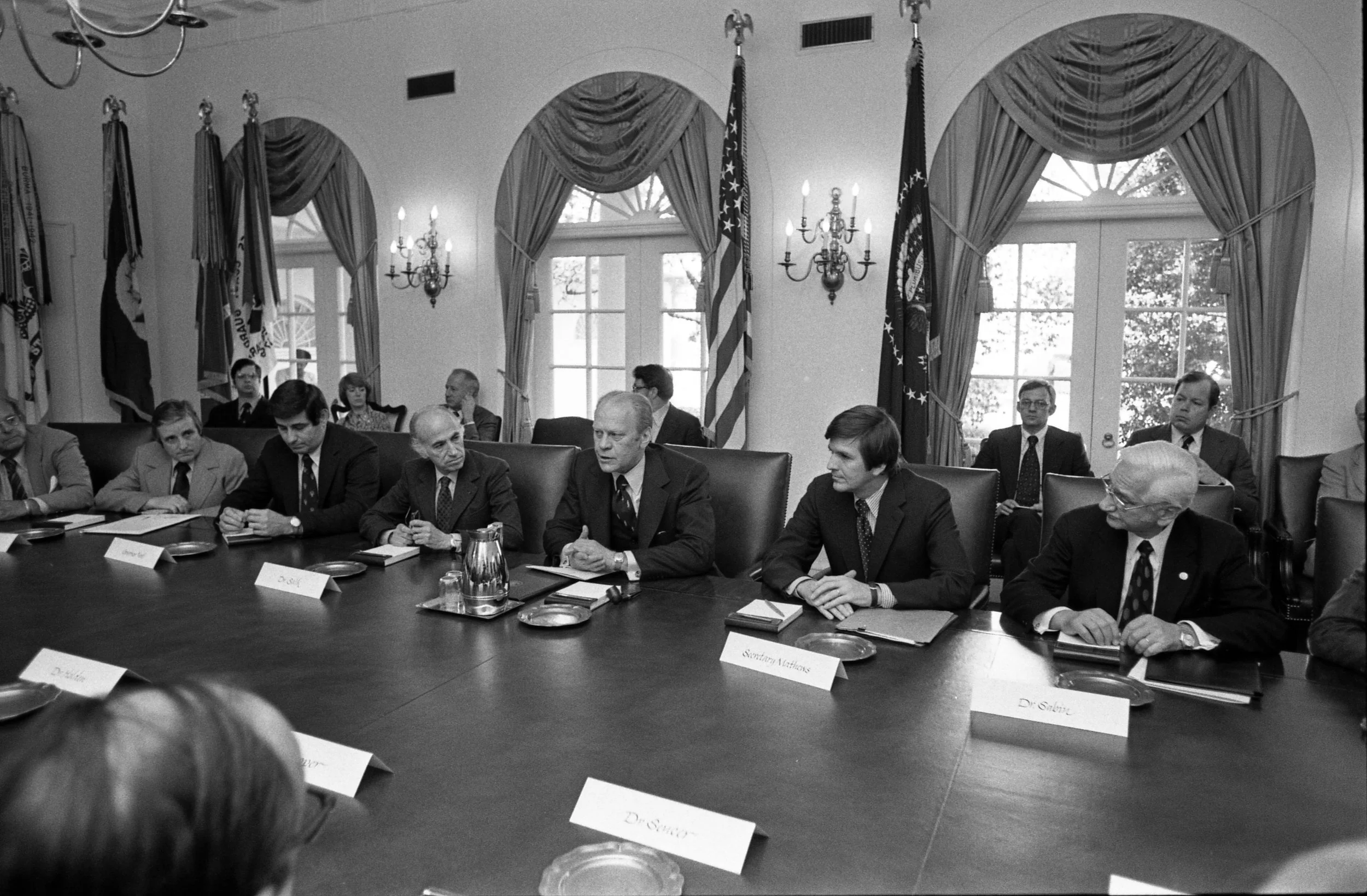
Mathews seated next to President Ford during a cabinet meeting, 1976.
On August 8, 1975, in the presence of his wife Mary and their two children, Mathews took the oath of office, as President Ford and other dignitaries looked on. “Dr. Mathews brings to this new mission the strength of youth, a sense of purpose, the skills of a scholar, and the trusted record of a successful leader and administrator,” Ford said. “I am confident that his achievements will speak for themselves in the months and years ahead.” (Click here to read the full transcript of President Ford’s remarks.)
Warren E. Burger, Chief Justice of the United States, administered the oath. “This occasion is a temptation to bold rhetoric,” Mathews observed as he began his comments. “But I have a strong sense that it should be avoided.... Grand promises seem insensitive to both the deep fears and the fragile hopes that are at the heart of matters this Department is charged to address.”
Mathews’ brief statement at his swearing-in ceremony serves as a useful outline of his professional life, in the Nation’s Capital and beyond. He spoke about the necessity of building partnerships and restoring trust. He suggested Americans counteract cynicism with a “common rethinking” and appealed for more active engagement in the lives of their communities. Mathews continued with a reference to a Founding Father and a belief in the power of cooperation:
Certainly it is the oldest of bromides to say that the strength of the nation is, ultimately and most basically, in the people—particularly in their self-reliance. But the saying still has an indisputable wisdom to it. Mr. Jefferson, even as a fierce champion of limited government, argued that “the care of human life and happiness...is the first and only legitimate object of good government.”
We have few illusions left about happiness, about building a heaven on earth, but we can still hope for a better earth. I have few illusions about what I can do even to that end, but I have considerable hope for what we might do together.
The full text of this speech hangs in the office of the David Mathews Center for Civic Life, located on the campus of American Village in Montevallo. For twenty years, the Center has worked to develop and sustain habits of good citizenship in Alabama communities through deliberative forums, teacher workshops, opportunities for place-based internships, and community service. We are guided along the way by a model informed by the thoughtful example of our organization’s namesake.
David Mathews served as HEW Secretary until the end of President Ford’s time in office in January 1977. Though brief, this tenure was notable for efforts to promote citizen participation and engagement in government affairs at the department. Over the next several years, the Mathews Center will publish a series of occasional articles examining this important time in modern American history. We will also highlight some of the other Alabamians who worked alongside Dr. Mathews in Washington, including several who later helped establish the Mathews Center. Among these “Alabamians at HEW” were Col. Floyd Mann, the former director of the Alabama Department of Public Safety who famously intervened to save the lives of Freedom Riders in 1961, as well as Joffre T. Whisenton, who in 1968, became the first African American to earn a Ph.D. from the University of Alabama, and more than a dozen others. “They, too, influenced how I saw Washington,” Mathews wrote in 2022, “some adding the perspective of a younger generation.”
We view this series not merely as an historical accounting, but rather as a chance to reflect upon how the ideals that drive the work of the David Mathews Center—ideals including the importance of a deliberative citizenry and a participatory government—were formed.