From Conversation to Action: Youth Mental Health in Clay County
From connection to collaboration to action. The communities of Ashland and Clay County are putting those words into practice, this time, through the lens of youth mental health.
At the beginning of the year, longtime community partner Tina Nolen, Director of the Ashland Public Library, reached out to the DMC to spark a deeper conversation around bullying among local youth. While she had gathered insights from adult community members, one key perspective was still missing: the voices of young people themselves. However, that missing piece walked through the library doors just a few weeks later.
Camryn Humphries, a junior at Clay County High School, is a participant in the first cohort of 4-H Leadership Academy’s Roth Scholars. Funded by a $1.1M gift from Atlanta-based businessman and philanthropist Joel Roth, this two-year pilot program equips 25 high school students across the country with skills in communication, leadership, ethics, conflict resolution, and social responsibility. Roth Scholars also receive stipends to conduct research and implement community-based projects grounded in the lessons learned.
Focusing her project on youth mental health in Clay County, Humphries teamed up with Nolen to convene a conversation at the Ashland Public Library, bringing together community actors, including the DMC, SAFE House, Ashland Police Department, and more, to co-create a plan. Through a partnership with the Mathews Center and a connection at Clay Central Junior High School, the group decided to facilitate a day of student conversations aimed at uncovering the root concerns facing local youth.
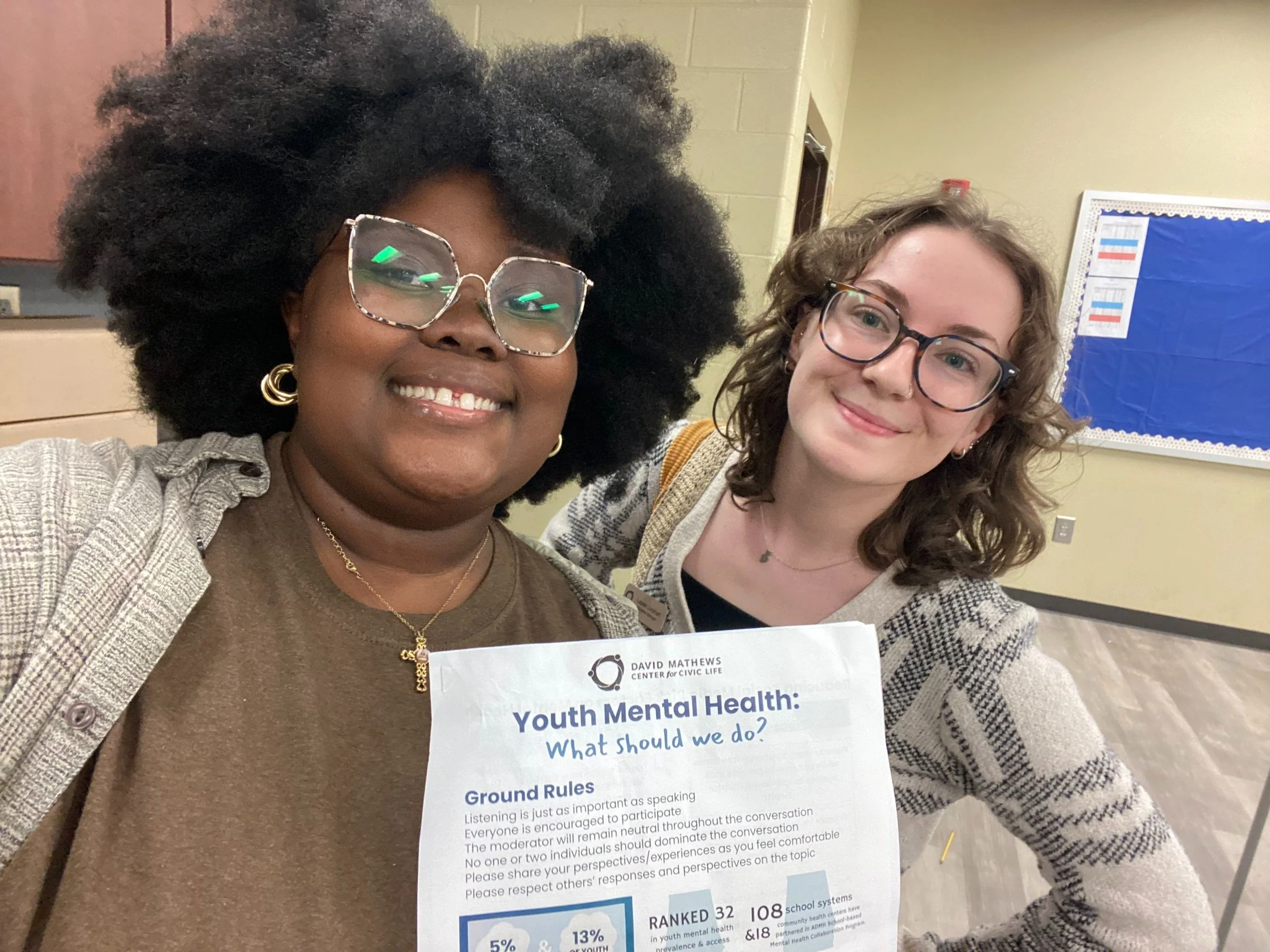
Drawing from prior research developed with Dr. Mark Wilson at Auburn University, McKenzie Civic Fellow Chauntina Whittle crafted an issue guide specifically designed to spark dialogue around youth mental health in Alabama. This guide gave the group a shared framework to tackle what many consider a “wicked problem.” Dr. David Mathews, the DMC”s namesake, defines a “wicked problem” as ones that are “so deeply embedded in the social fabric that they never completely go away. They are as tricky as they are aggressive…. Coping with these problems requires sustained civic action.”
On Monday, April 7th, the Mathews Center joined Humphries at Clay Central Junior High for a full day of mental health conversations with 7th and 8th graders. With Whittle as lead facilitator and DMC Education Manager Lauren Lockhart as notetaker, students explored the complexities, trade-offs, and potential actions tied to mental health in their schools and communities.
By the end of the day, several key themes emerged from the students’ conversations:
Mental Health Matters - But It’s Hard to Talk About
Social Media Is Both Helpful and Harmful
Bullying (Especially Online) Is Damaging and Complex
Peer Support Is Powerful
Adult Support Can Be Hit or Miss
Schools Need to Do More - and Show They Care
And with those came a set of action items:
Expand Mental Health Education
Develop Peer Support Programs and Foster a Community of Empathy
Implement Smart Social Media Practices
Improve Mental Health Service Accessibility
Address Bullying Through Holistic, Fair Practices
In addition to their conversations with the DMC, students also engaged with a SAFE House representative, who provided instruction and resources on relationship safety and reporting. As she moves into the final stages of her project, these direct insights and reflections are giving her a solid foundation to continue working with her community to make a difference.
To finish her program, Humphries will bring together community partners, residents, and students at the end of the summer for a fun run held during the town’s Saturday market, an event designed to raise both awareness and funds for youth mental health initiatives. Although her time as a Roth Scholars may be ending, Humphries has made it clear that her commitment to mental health advocacy is just beginning. She hopes to continue supporting Clay County, and beyond, as she steps into her future.
The Mathews Center is honored to partner with the dedicated people of Ashland and Clay County in creating spaces where every voice can be heard.
Interested in hosting a conversation around a “wicked problem” in your own community? Reach out to us at dmccl@mathewscenter.org to learn more.